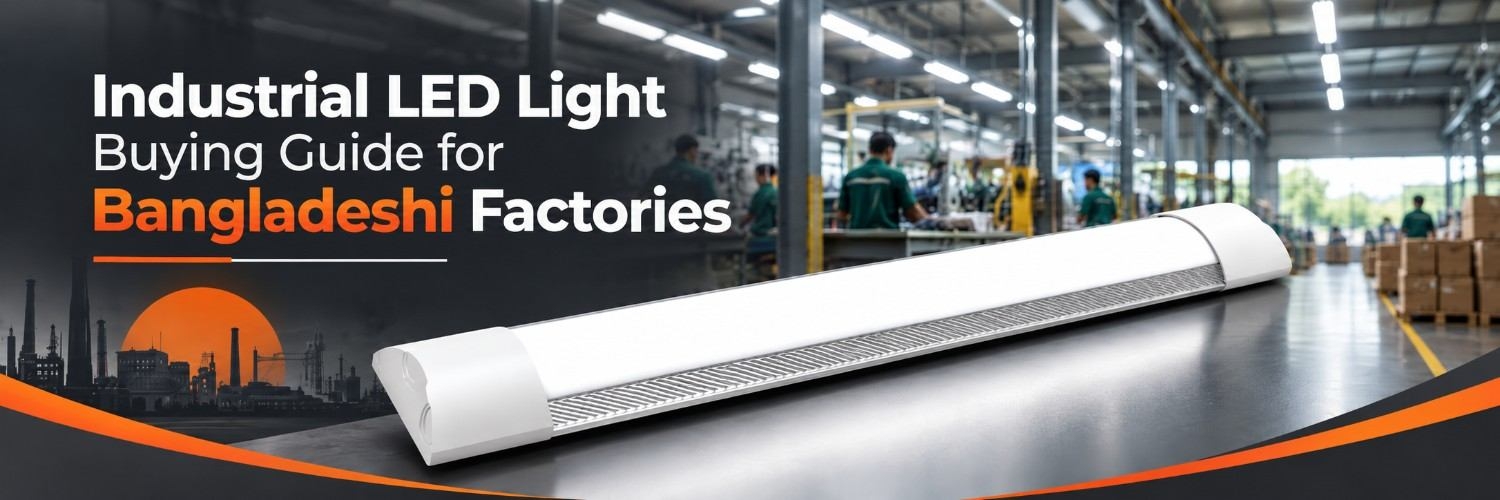
Industrial LED Light Buying Guide for Bangladeshi Factories
Light October 17, 2026
Walk into an older factory in Gazipur or a warehouse in Narayanganj, and you can often spot the problem before anyone says a word. Some corners are bright, others are gloomy, and a few fixtures hum or flicker overhead. Workers squint at their stations while the monthly electricity bill keeps climbing.
Switching to LED fixes most of this, but only if you buy the right fixtures. A light that looks impressive in a showroom can fail within a year under a hot tin roof, daily voltage swings and a steady layer of cotton dust. That is why choosing industrial LED lighting is very different from picking a bulb for your home.
This industrial LED light buying guide walks you through what really matters: the main fixture types, the specifications worth checking on a datasheet, how to estimate the number of lights you need, and the local conditions that decide whether a fixture survives in Bangladesh. By the end, you will know exactly what to ask a supplier before you sign a purchase order.
Why Industrial LED Lighting Is Worth the Switch
Many older industrial sheds in Bangladesh still run on metal halide lamps, fluorescent tubes or a mix of both. They work, but they waste a lot of power as heat and lose brightness steadily over time. Modern LED fixtures turn far more of each watt into usable light, which is why energy-efficient industrial lighting has become a standard part of factory upgrades.
The benefits go well beyond the electricity bill:
-
Instant light after a power cut: A metal halide lamp has to cool down before it can restrike, so full brightness can take 8 to 15 minutes to return after an outage. LEDs come back the moment grid power or the generator kicks in.
-
Less heat on the floor: LED fixtures radiate far less heat downward, which workers notice during long summer shifts.
-
Lower maintenance: Quality fixtures are rated for tens of thousands of hours, so your team spends less time on ladders and scissor lifts.
-
Better safety and accuracy: Even, flicker-free light reduces eye strain and helps workers spot defects and hazards.
If you want to see how the savings add up in real numbers, our LED light vs traditional bulb comparison breaks it down clearly.
Types of Industrial LED Light Fixtures
Before you compare specifications, decide which fixture type suits each zone of your building. Most facilities end up needing two or three types, not just one.
UFO (Round) High Bay LED Lights
High bay LED lights are the workhorse of buildings with ceilings around 6 metres or higher. The round UFO style packs a lot of output into a compact body, with a large heat sink on top to carry heat away. It is a popular choice for open production floors, workshops and steel-structure sheds.
Linear High Bay Fixtures
Linear high bays spread light along a long, rectangular body. They suit warehouses with tall racking because you can run them along the aisle. They also work well over sewing lines, where long rows of machines need even light from end to end.
LED Flood Lights
Flood lights throw a wide, powerful beam and are built for outdoor duty. Factories use them for yards, loading bays, boundary walls and parking areas, and sometimes inside tall open sheds. Our post on the conventional and exceptional uses of LED flood lights shows where they perform best.
Battens, Tubes and Panels
For ceilings under about 4 metres, such as offices, quality control rooms, canteens and corridors, slim battens or panels give comfortable light without harsh glare. If you are fitting out those areas, our LED panel light guide explains how to pick the right one.
Explosion-Proof and Special Fixtures
Paint booths, chemical stores and some pharmaceutical areas may need fixtures certified for hazardous locations. Standard high bays are not safe there, so always involve a qualified electrical engineer for these zones.
Key Specifications to Check Before You Buy
A datasheet tells you far more than a brochure. These are the numbers that separate the best industrial LED lights from cheap look-alikes.
Lumens and Efficacy, Not Just Watts
Wattage shows how much power a fixture uses, not how much light it gives. Check the total lumen output, then divide it by the wattage to get efficacy in lumens per watt (lm/W). Good industrial fixtures commonly fall between 90 and 150 lm/W, and a higher figure means lower running costs for the same brightness.
Mounting Height and Beam Angle
The higher you mount a fixture, the more lumens it needs and the narrower its beam should be. Treat this table as a starting point, not a final design.
Mounting height | Typical output per fixture | Suggested beam angle |
4 to 6 m | 10,000 to 15,000 lm | 90° to 120° |
6 to 9 m | 15,000 to 25,000 lm | 90° (60° over racking) |
9 to 12 m | 25,000 to 35,000 lm | 60° to 90° |
Above 12 m | 35,000 lm or more | 60° or narrower |
Colour Temperature and CRI
Most production floors work well at 4000K to 5000K, a neutral to cool white that keeps people alert. Many Bangladeshi buyers prefer 6500K daylight, which suits yards, warehouses and security lighting. For general work, a Colour Rendering Index (CRI) of 80 is enough. Shade matching in garment, dyeing or printing units needs CRI 90 or higher.
IP and IK Ratings
The IP rating shows how well a fixture keeps out dust and water. IP65 is a sensible minimum for dusty or humid production areas, while outdoor and wash-down zones are better served by IP66 or IP67. Where forklifts or cranes operate, also look for an impact rating of IK08 or higher.
Driver, Surge Protection and Power Factor
The driver is usually the first part of an LED fixture to fail. Look for an isolated driver with open and short circuit protection, a wide input range such as 100 to 265V AC, surge protection of at least 4 kV and a power factor above 0.9. Driver problems are also a common cause of flicker, as our guide on how to fix a flickering LED light explains.
Flicker is more than an annoyance in a factory. It can make spinning machinery look slower or even still, which is called the stroboscopic effect. Ask for low-flicker drivers wherever lathes, cutters or fans are running.
Heat Management
Heat shortens LED life faster than anything else. A die-cast aluminium heat sink with open fins carries heat away from the chips. Check the rated operating temperature too, because the air under a tin roof gets much hotter than the street outside. A rating of 50°C gives you a safer margin.
Lifespan, Warranty and Test Reports
A headline figure of 50,000 hours means little on its own. Look for the L70 rating, which tells you how long the fixture keeps at least 70% of its original brightness. Then check whether the warranty covers the driver, and ask for LM-79 and LM-80 test reports. Our article on how to choose the best quality LED light covers more quality checks.
How Many Industrial LED Light Fixtures Do You Need?
The right number of fixtures depends on how bright each area needs to be. The European EN 12464 lighting standards are a widely used reference, and their recommended levels look like this:
Area | Recommended light level |
Outdoor yards and walkways | 20 to 50 lux |
Bulk storage | 100 to 200 lux |
Packing and dispatch | 300 lux |
General production | 300 to 500 lux |
Cutting, sewing and finishing | 750 lux |
Quality control and colour inspection | 750 to 1,000 lux |
A Quick Way to Estimate Fixture Count
You can get a rough number with this simple formula:
Fixtures = (Target lux × Floor area in m²) ÷ (Lumens per fixture × 0.65 × 0.8)
The 0.65 accounts for light lost to walls, racks and the ceiling, while the 0.8 allows for dust and gradual LED ageing.
Here is a practical example. Say you run a 1,000 m² warehouse in Gazipur with an 8-metre ceiling and you want 200 lux. Using 20,000-lumen high bays, the maths is -
(200 × 1,000) ÷ (20,000 × 0.65 × 0.8) = 19.2
So you would plan for 20 fixtures in a 5 × 4 grid. Turn the same space into a sewing floor at 750 lux, and you would need roughly 73 of the same fixtures.
Treat this as a ballpark figure. For the final layout, ask your supplier for a lighting simulation in software such as DIALux, which maps lux levels across the whole floor. For office, canteen and showroom areas inside the facility, LAXFO's free lumen calculator gives a quick estimate.
What Makes Industrial Lighting in Bangladesh Different
A fixture that performs well in a mild climate can struggle here. These local conditions should shape your shortlist.
Voltage Swings and Generator Changeovers
Many industrial zones deal with voltage dips, spikes and frequent switching between grid power and generators. Each changeover can push a surge through the lighting circuit, so wide input voltage and solid surge protection are essentials, not extras. Protect lighting circuits with correctly sized breakers as well; our circuit breaker buying guide explains where MCBs and MCCBs fit in a factory setup.
Heat, Humidity and the Monsoon
Pre-monsoon heat bakes metal roofs, then months of high humidity follow. Choose sealed fixtures rated IP65 or higher, with corrosion-resistant coatings and a high operating temperature rating. Units near rivers or the coast, such as those around Chattogram, should pay extra attention to corrosion resistance.
Dust and Lint in Textile Units
Spinning, knitting and garment units produce a steady layer of fibre dust. Dust on a heat sink traps heat, and dust on the lens cuts light output. Pick fixtures with open-fin heat sinks that are easy to wipe clean, and add lens cleaning to your maintenance schedule.
Backup Lighting for Exit Routes
Buyer audits and fire safety inspections in the RMG sector look closely at exit routes and stairwells. Your main fixtures will not help during a total blackout, so plan battery-backed lighting for escape routes. Our guide to emergency lights in Bangladesh covers the options.
Common Mistakes to Avoid When Buying Industrial LED Lights
Even experienced buyers fall into these traps:
-
Buying by wattage alone. Two 150W fixtures can differ in output by thousands of lumens, so always compare lumens and efficacy.
-
Choosing the cheapest unbranded fixture. Without a proper datasheet, you cannot know what driver or LED chips sit inside, and early replacements quickly wipe out the savings.
-
Swapping lamps one for one. Replacing every old metal halide lamp with a single LED often over-lights some areas and leaves others dark. Plan the layout fresh.
-
Ignoring glare. High-output fixtures mounted too low can dazzle workers. Use diffusers, reflectors or a better-suited beam angle.
-
Skipping controls. Motion sensors in quiet aisles and daylight sensors near skylights cut consumption even further. Our list of the best energy-saving LED lights in Bangladesh shares more ways to save.
-
Not reading the warranty. A long warranty means little if it excludes the driver or has no local service support.
How to Choose the Right Supplier
Even the best industrial LED lights only deliver if the supplier stands behind them. Before you place a bulk order, ask for:
-
Full datasheets and test reports for the exact model you are buying
-
A sample fixture to trial in your own facility for a few weeks
-
A lighting layout or simulation for your space
-
Clear warranty terms, local service and stock for future replacements
LAXFO LED Flood Lights for Industrial Sites
For yards, loading bays, perimeter walls and tall open sheds, LAXFO's LED flood lights include several of the features covered above. All three models run on a wide AC 100 to 265V input, use isolated SMPS drivers with open and short circuit protection, and carry an IP67 rating. They also offer a power factor above 0.90, a 120° beam, 6500K daylight output and a die-cast aluminium body rated for 0 to 50°C.
Model | Light output | Surge protection | Price |
9,000 lm | 2 kV | Tk 5,900 |
|
13,500 lm | 4 kV | Tk 10,500 |
|
18,000 lm | 4 kV | Tk 13,900 |
Prices are as listed on the LAXFO website at the time of writing and may change.
Ending Note
Buying industrial LED lighting is not about finding the brightest or the cheapest fixture. It is about matching the right fixture type to each zone, reading the datasheet carefully and choosing products that can handle Bangladesh's heat, humidity, dust and unstable power.
Start with the light level each area needs. Then shortlist fixtures with dependable drivers, proper IP ratings and honest L70 figures, and trial a sample before you commit. Done right, an LED upgrade pays you back every month through lower bills, fewer replacements and a safer, more productive floor.
Planning a lighting upgrade for your factory or warehouse? Get in touch with the LAXFO team to talk through your space and find fixtures that fit.
Frequently Asked Questions
What is the best LED light for a factory in Bangladesh?
There is no single best model for every factory. For ceilings above about 6 metres, LED high bay lights are usually the right choice, while flood lights suit yards and loading areas. Look for IP65 or higher, surge protection of at least 4 kV, a wide input voltage range and a power factor above 0.9.
How many lumens do I need to light a warehouse?
General storage areas need about 100 to 200 lux, while packing and dispatch zones need around 300 lux. Multiply the target lux by the floor area, then divide by the usable lumens per fixture. For example, a 1,000 m² warehouse at 200 lux needs roughly 20 high bays of 20,000 lumens each.
What is the difference between high bay and low bay LED lights?
High bay lights are designed for ceilings around 6 metres and above, with higher output and more focused beams. Low bay lights suit ceilings below about 6 metres and use wider beams to spread light over a shorter distance.
What IP rating is best for industrial LED lights?
IP65 is a good minimum for indoor factories with dust, lint or humidity. For outdoor yards, loading bays and wash-down areas, choose IP66 or IP67 so the fixture can handle heavy rain and water jets.
How long do industrial LED lights last?
Quality industrial LED fixtures are often rated for 30,000 to 50,000 hours or more. The most useful figure is the L70 rating, which shows how long the light keeps 70% of its original brightness. In a factory running two shifts of about 16 hours a day, 50,000 hours works out to roughly eight and a half years.
Related Blogs