Circuit Breaker Buying Guide: Types, Amperage and Compatibility (2026)
Accessories August 24, 2026
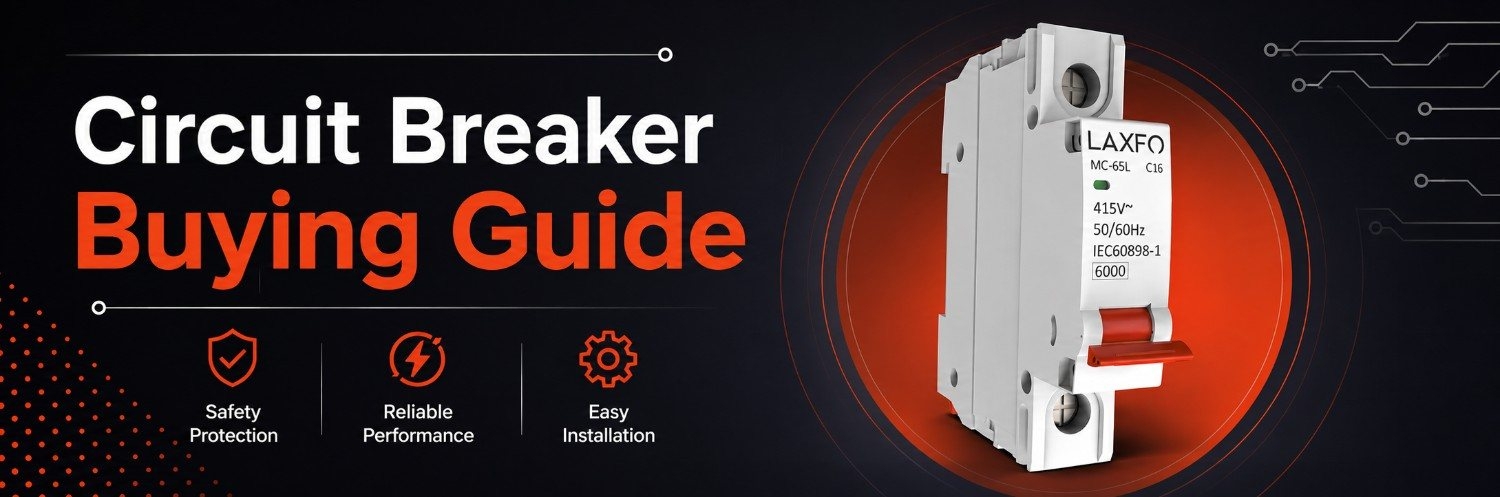
It is 9 PM. The AC is running, the refrigerator is humming, and someone in the kitchen just switched on the microwave. And right at the moment everything goes dark.
You reset the breaker. A few days later, same thing. This time you decide to replace it. You head to the hardware shop and stand in front of a shelf packed with MCBs, RCCBs, and MCCBs in different sizes and price tags. Which one do you actually need?
That is what this guide answers. By the end, you will know which type suits your setup, how to calculate the right amperage, and how to confirm the breaker you pick is compatible with your panel before you hand over any money.
So, without further ado, let’s get started.
The Types of Circuit Breakers You Will Find in Bangladesh
Not all circuit breakers do the same job. Using the wrong type is just as risky as using the wrong size. Here are the four main types available in the Bangladeshi market.
MCB (Miniature Circuit Breaker)
The MCB is the most common circuit breaker in Bangladeshi homes, shops, and offices. It protects your wiring against two things: overloads (too much current running for too long) and short circuits (a sudden, dangerous surge of current). Compact and DIN-rail mounted, MCBs are available from 6A to 63A. They come in three trip curve types. B-curve trips fastest and works well on lighting circuits with no startup surge. C-curve is the standard for socket and appliance circuits, including AC units, because it tolerates a small inrush of current on startup without tripping unnecessarily. D-curve handles heavy motor loads. Most Bangladeshi homes run on C-curve MCBs throughout. MCBs are governed by IEC 60898-1 and rated for 230/400V systems, which aligns with Bangladesh's 220V single-phase supply.
MCCB (Molded Case Circuit Breaker)
The MCCB is a heavier-duty device with adjustable trip settings. It handles fault currents that would overwhelm a standard MCB, rated from a few amps all the way up to 2,500A. You will find MCCBs in garment factories, commercial buildings, multi-storey apartment complexes, and any setup where the total electrical load goes well beyond what a standard MCB can manage. Governed by IEC 60947-2.
RCCB (Residual Current Circuit Breaker)
Here is a point most people miss entirely. An RCCB does not protect against overloads or short circuits. What it does is protect people. It monitors the difference between current leaving on the live wire and returning on the neutral. The moment it detects a mismatch, which happens when current is leaking to earth (often through a person), it trips in milliseconds. A 30mA sensitivity RCCB is the standard for personal protection. An RCCB must always be paired with an MCB. Using one without the other leaves you exposed to whichever risk the missing device would have covered.
RCBO (Residual Current Breaker with Overcurrent Protection)
An RCBO combines the MCB and RCCB into one compact unit. It protects against overloads, short circuits, and earth faults all at once. A practical choice for newer apartments with limited distribution board space.
Now, let's see a comparative overview between them with the following table.
Type | Protects Against | Common Use in Bangladesh | IEC Standard |
MCB | Overload, short circuit | Homes, offices, shops | IEC 60898-1 |
MCCB | Overload, short circuit (high current) | Factories, large commercial | IEC 60947-2 |
RCCB | Earth leakage, electric shock | Paired with MCB in homes | IEC 61008-1 |
RCBO | Overload, short circuit, earth leakage | Space-saving residential setups | IEC 61009-1 |
Where to Use Which Circuit Breaker
Knowing what each type is gets you halfway. The other half is knowing which one belongs in your specific situation, because a breaker that is perfectly suited for a home can be dangerously undersized in a factory.
For Residential homes and apartments
MCBs throughout all circuits. Pair them with an RCCB on the main incoming supply, or use RCBOs on bathroom and kitchen circuits where water contact is a real risk. A typical Dhaka apartment runs C-curve MCBs across the board with one RCCB covering the whole installation.
For Small commercial (shops, offices, clinics)
MCBs still handle individual circuits well. If the total incoming load exceeds what a single MCB can manage, an MCCB takes over as the main breaker. Add an RCCB on socket circuits where staff plug in equipment throughout the day.
For Large commercial (malls, hospitals, hotels)
MCCBs become the primary protection layer here, with adjustable trip settings coordinated with downstream MCBs. A sudden trip in a hospital or hotel is an operational emergency. Reliability matters more than cost savings at this level.
For Industrial (garment factories, manufacturing plants)
Standard residential MCBs cannot handle industrial fault currents. MCCBs are the minimum, with ACBs (Air Circuit Breakers) handling the main incoming supply at very high fault levels. Motor circuits need D-curve MCBs or dedicated motor protection breakers to survive startup inrush without nuisance tripping.
The simple rule: As load and fault current go up, step from MCB to MCCB to ACB. As personal safety risk goes up (water, public access, exposed wiring), add RCCB or RCBO protection alongside your overcurrent device.
How to Choose the Right Amperage
The amperage rating tells you how much current the breaker allows before tripping. Getting this right comes down to two steps.
First, calculate your circuit load. Add up the wattage of all appliances on that circuit, then divide by your supply voltage (220V in Bangladesh) to find the amperage draw.
Second, apply the 80% rule. A circuit breaker should not carry more than 80% of its rated current on a continuous basis. A 20A breaker should carry no more than 16A continuously. This buffer stops the breaker from running hot under sustained load and helps it last significantly longer.
For a typical Bangladeshi apartment at 220V, here is a practical starting point:
-
Lighting circuit: 6A MCB
-
General socket circuit: 16A or 20A MCB
-
AC unit (1 to 2 ton): 20A or 32A on a dedicated circuit
-
Water heater: 20A or 25A on a dedicated circuit
One rule you must never break: Do not upsize the breaker without upsizing the wire. The breaker's entire job is to protect the wire. If the breaker's rating exceeds the wire's capacity, the wire will overheat under load before the breaker ever responds. That is how residential fires start.
One Bangladesh-specific tip worth knowing: C-curve MCBs are a better default than B-curve on socket and appliance circuits in areas with frequent voltage fluctuations. The slightly higher magnetic trip threshold cuts down nuisance tripping during power surges without removing any real protection.
LAXFO Circuit Breakers: The Best Option Built for Bangladesh
If you need an IEC 60898-1 certified MCB designed for Bangladesh's 220V/50Hz environment, LAXFO's circuit breaker range is worth a close look. LAXFO is a Bangladeshi electronics manufacturer focused on producing affordable, quality-tested electrical products built for local conditions.
Every LAXFO MCB carries a 6kA short-circuit capacity, runs a C-curve trip characteristic suited to appliance and socket circuits, and features fire-resistant V0-rated housing. IP20 protection guards against dust and accidental contact. Each unit is rated for 10,000 electrical operations and 20,000 mechanical operations, which puts these well above disposable-grade territory.
Here is the current range and where each one fits:
-
10A Single Pole MCB (SPC10-6): Lighting circuits
-
16A Single Pole MCB (SPC16-6): General socket circuits
-
20A Single Pole MCB (SPC20-6): Dedicated 1-ton AC circuits
-
25A Single Pole MCB (SPC25-6): Water heaters and heavier appliance circuits
-
32A Single Pole MCB (SPC32-6): 1.5 to 2-ton AC units and higher-load dedicated circuits (Tk.290)
-
6A Double Pole MCB (DPC6-6): Low-load circuits requiring protection across both live conductors (Tk.535)
Frequently Asked Questions
How to know which circuit breaker to buy?
Look at three things: the type of protection the circuit needs (MCB, RCCB, or RCBO), the amperage of the circuit, and the compatible brand listed on your DB door. The label inside your distribution board answers the third question instantly. Match all three and you have the right breaker.
What is the 80% rule for circuit breakers?
A circuit breaker should not carry more than 80% of its rated current on a continuous basis. A 20A breaker should carry no more than 16A continuously. This buffer prevents the breaker from running hot under sustained load and extends its working lifespan.
Can I use a 32 amp MCB for a 1.5 ton AC?
It will work, but it is oversized for the job. A 1.5 ton AC typically draws 7A to 8A at 220V during normal operation. A 20A C-curve MCB is the standard recommendation. It gives enough headroom for the compressor's startup surge while still protecting the circuit wire properly. With a 32A breaker on that same wire, the wiring would need to overheat significantly before the breaker ever reacts.
Is a 100 amp breaker enough for a house?
For most homes and apartments in Bangladesh, yes. A typical household running two to three AC units, a refrigerator, a washing machine, and general lighting rarely pulls more than 70A to 80A in actual demand. Larger homes with multiple heavy appliances may need 125A or 160A on the incoming supply. Calculate your total load first.
How do I calculate the correct size for a circuit breaker?
Add the wattage of all appliances on the circuit. Divide by 220 to find the amperage draw. Then divide that number by 0.8 to apply the 80% rule. For example, a 2,200W circuit at 220V draws 10A, so a 16A MCB is the correct fit.
Is a 30 amp breaker 120 or 240?
This question comes from the US electrical system, where single-pole breakers serve 120V circuits and double-pole breakers serve 240V. In Bangladesh's 220V single-phase system, voltage and amperage are separate specifications. A 30A MCB here is rated for the 220V/230V supply regardless of pole count. If you need to protect both live conductors on a 220V circuit, you need a double-pole MCB. The amperage rating on the label does not change based on the voltage.
Ready to Buy? Here Is What to Do Next
Three decisions define the right circuit breaker: type, amperage, and panel compatibility. Get all three right and you have a safe, properly protected circuit. Miss any one of them and you either under-protect the circuit or end up with a breaker that fits the slot but does not work correctly. In Bangladesh, frequent power fluctuations and a real counterfeit market make these decisions more consequential than in countries with stable grid supply. Photograph your DB label before leaving the house. Calculate the load on the circuit you are replacing or adding. Decide whether you need an RCCB alongside your MCB or an RCBO that handles both in one unit. If your setup is anything more complex than a single standard replacement, a licensed electrician's assessment now costs far less than a rewire after a fault.